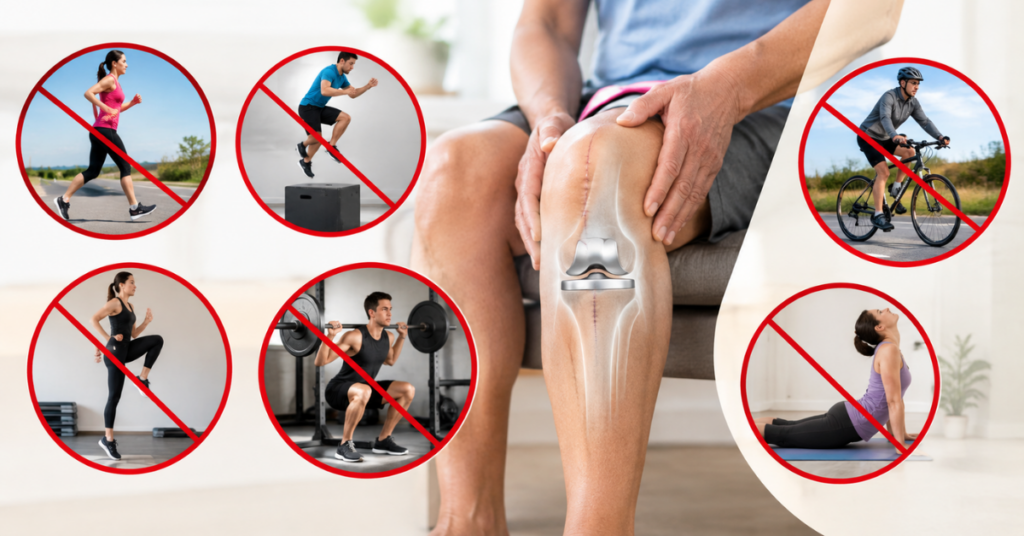
Knee replacement can ease pain and improve movement, but recovery takes time. Rehabilitation is a crucial part of recovery but some activities can put too much stress on the healing knee. Understanding which exercises to avoid or modify can aid in recovery and lower injury risk.
Exercises To Avoid Or Change After Knee Replacement
High Impact Exercises
High-impact activities can cause repeated stress on the knee joint. In general, running, jogging, jumping, aerobics with repeated jumping, and similar exercises should be avoided in early recovery. Some patients may not be recommended these activities long term. These activities can put extra strain on your joints and cause them to swell or become sore.
Deep Squats And Over Kneeling
Deep squats can be tough on the knee, especially in the early stages when strength and flexibility aren’t back. Patients may have to limit how far they bend their knee and follow the range of motion their physiotherapist advises.
You might also find kneeling uncomfortable after surgery. Some people may be able to kneel from time to time, but they should avoid doing so too much or for too long unless the surgical team says it is alright.
Twists, Turns, And Heavy Workouts
The knee can be put under stress by sudden twisting or pivoting movements. Introduce activities involving rapid changes of direction if allowed, carefully.
You may also need to modify heavy lifting and strenuous gym workouts. Too much resistance too soon can increase pain, swelling or strain around the healing joint. Promotion should be gradual and in the hands of the professional people.
Healthier Ways To Get Active
Rehabilitation usually includes walking, prescribed physiotherapy exercises, stationary cycling and low-impact strengthening. If the wound is healing well and your surgeon gives the OK, swimming might also be an option. But the right activity and timing is dependent on the individual.
Your exercise plan should take into account healing, implant type, surgical approach, general health, strength and what your surgeon or physiotherapist recommends. If you experience increasing pain, swelling, redness, wound problems, or other unusual symptoms from exercise, stop the activity and seek medical advice. Patients considering knee replacement surgery in Indore should consult an orthopedic surgeon to discuss a customized rehabilitation and exercise plan to ensure that activities are advanced safely.
FAQs
Can I run after knee replacement surgery?
Everyone may not be advised to run because of the repeated high impact forces that running creates. Before you get back to running, check with your orthopedic surgeon.
Can you squat after knee replacement?
As strength improves, many patients can do modified squats but deep squats may need to be avoided or limited. Stick to your rehab program.
Can I cycle after a knee replacement?
Stationary cycling is frequently used during rehabilitation but timing depends on healing and movement of the knee. Obtain clearance before beginning.
How soon can I begin exercising again after my knee replacement?
Light activity is often introduced during early rehabilitation while more demanding exercises are introduced gradually. Your surgeon or physiotherapist can advise when.
Safest exercises to do following knee replacement?
Walking , prescribed physiotherapy exercises , low-impact strengthening and stationary cycling are commonly used . It is contingent upon the individual’s recovery.