
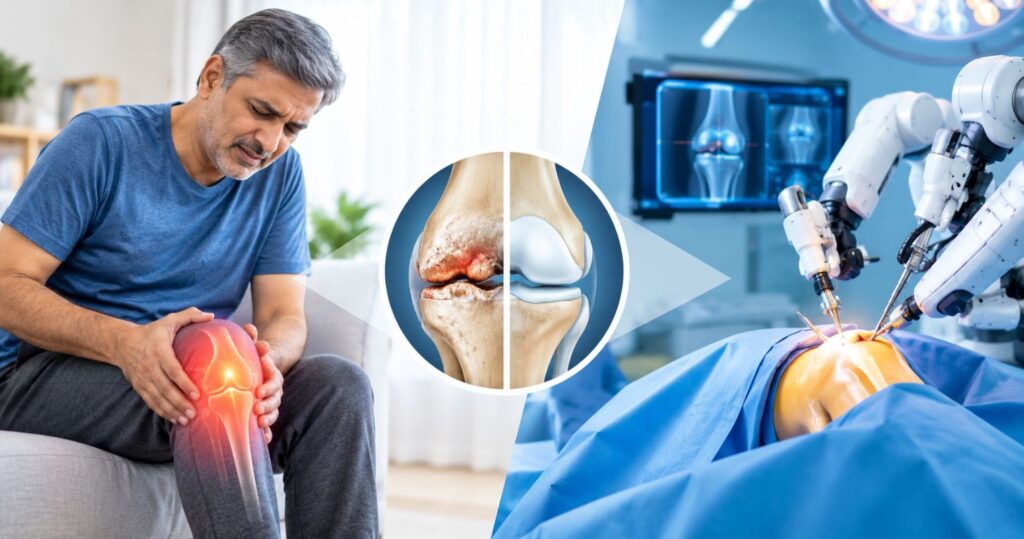
Knee pain and stiffness can gradually become a part of everyday life, especially when the knee joint becomes severely worn due to osteoarthritis. Simple activities such as walking, climbing stairs, standing up from a chair, or sitting for long periods may become difficult.
When pain continues despite medicines, physiotherapy, lifestyle changes, or other treatments, robotic knee replacement surgery may be considered in suitable patients.
Why Does Knee Joint Wear Cause Pain and Stiffness?
The knee joint has a smooth layer of cartilage that allows the bones to move comfortably. With osteoarthritis, this cartilage gradually becomes thin or damaged. As the joint becomes more worn, the bones may move less smoothly, causing:
- Persistent knee pain
- Stiffness, particularly after resting
- Swelling around the knee
- Difficulty walking
- Pain while climbing or descending stairs
- Difficulty getting up from a chair
- Reduced knee movement
- A feeling of weakness or instability
The severity of symptoms can vary from person to person.
When Can Knee Replacement Become Necessary?
Not every person with knee pain needs knee replacement surgery. Surgery may be considered when:
- Knee pain is persistent or severe
- Pain interferes with daily activities
- Walking has become difficult
- Knee stiffness significantly limits movement
- Medicines and other non-surgical treatments provide insufficient relief
- X-rays or other evaluations show advanced joint damage
- The overall condition and health of the patient make surgery appropriate
A detailed evaluation by an orthopedic surgeon is important before deciding on surgery.
What Is Robotic Knee Replacement Surgery?
Robotic knee replacement is an advanced approach that uses computer-assisted technology to help the surgeon plan and perform the procedure. Before surgery, detailed imaging and digital planning can help assess the patient’s knee anatomy and joint damage.
During the procedure, the surgeon uses the robotic system as an aid while removing damaged bone and positioning the knee implant according to the surgical plan.
The robotic system assists the surgeon; it does not perform the surgery independently.
What Are the Possible Benefits?
Depending on the patient’s condition and the surgical technique used, robotic assistance may help with:
- Detailed preoperative planning
- Assessment of individual knee anatomy
- More controlled bone preparation
- Accurate implant positioning
- Personalized surgical planning
The expected outcome can differ depending on factors such as the severity of arthritis, overall health, implant choice, rehabilitation, and surgical technique.
Is Robotic Knee Replacement Suitable for Everyone?
Robotic surgery is not automatically the best choice for every patient with knee arthritis. The decision depends on the extent of joint damage, symptoms, age, activity level, medical history, and other individual factors.
An orthopedic consultation and appropriate imaging are necessary to determine whether knee replacement—and whether a robotic-assisted approach—is suitable.
What Happens After Surgery?
Recovery involves more than the surgery itself. Patients are generally guided through a rehabilitation program that may include prescribed exercises, physiotherapy, walking practice, and gradual return to daily activities.
Following the orthopedic surgeon’s postoperative instructions can support recovery and help improve knee function.
Do Not Ignore Persistent Knee Pain
If knee pain and stiffness are making it difficult to walk, climb stairs, or perform routine activities, it is important to get the condition evaluated rather than continuing to ignore the symptoms.
For patients with advanced knee joint damage who have not achieved adequate relief with non-surgical treatment, robotic knee replacement surgery in Indore may be one of the treatment options to discuss with an orthopedic surgeon.
A proper clinical evaluation can help determine whether knee replacement is required and which surgical approach is appropriate for your condition.