
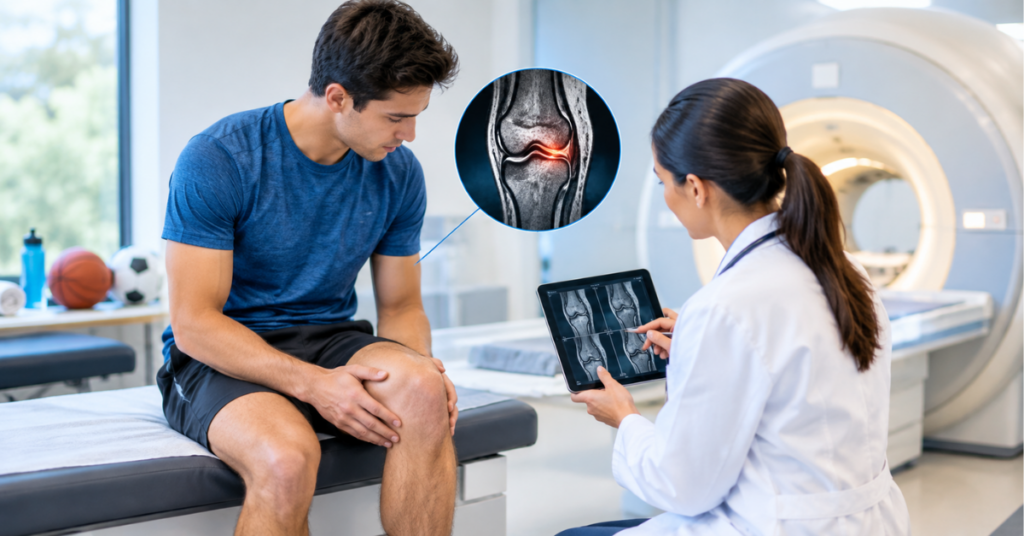
Sports injuries can happen during running, jumping, training, or contact sports. A sprain, strain, or sudden pain does not always mean you need an MRI. In many cases, a doctor can understand the injury through your symptoms, medical history, and physical examination.
When Is An MRI Needed?
An MRI is an imaging test that uses magnets and radio waves to create detailed pictures of the inside of the body. Unlike an X-ray, it can show many soft tissues clearly.
A doctor may recommend an MRI when the injury is more serious or when the examination suggests damage that needs a closer look. An MRI may help identify:
- Ligament injuries, such as ACL or other knee ligament tears
- Meniscus or cartilage problems
- Tendon injuries
- Muscle injuries
- Certain joint and other soft-tissue problems
However, an MRI is not automatically needed after every sports injury.
What Does a Doctor Check First?
Before deciding on imaging, a doctor usually asks how the injury happened and what symptoms you are experiencing. They may check swelling, movement, strength, tenderness, and joint stability.
For some injuries, an X-ray may be more appropriate, especially when a fracture or bone problem is suspected. Ultrasound can also be useful for assessing certain muscles, tendons, and other soft tissues. The right imaging test depends on the suspected injury.
When Symptoms Continue
Sometimes an injury appears mild at first but does not improve as expected. Persistent pain, swelling, instability, restricted movement, or weakness may lead a doctor to consider further imaging.
An MRI may also be useful when initial treatment has not helped or when the doctor suspects a significant ligament, cartilage, tendon, or muscle injury. Getting an MRI without medical assessment may not provide useful answers and can sometimes identify findings that are not causing the symptoms.
When Should You See An Orthopedic Doctor?
Seek medical evaluation if pain is severe, you cannot put weight on the injured area, the joint feels unstable, swelling is significant, or normal movement is difficult. A sports injury should also be assessed if symptoms continue or interfere with daily activities or exercise.
A proper evaluation helps determine whether you need rest and rehabilitation, further tests, or specialist care. If an MRI is appropriate, your doctor can recommend it as part of Sports Injury Treatment in Indore, based on your symptoms and examination rather than simply because an injury occurred.
FAQs
1. Does every sports injury need an MRI?
No. Many sports injuries can be assessed through a physical examination and medical history without an MRI.
2. When might a doctor recommend an MRI?
An MRI may be recommended when a significant soft-tissue injury is suspected or symptoms continue despite initial treatment.
3. Is an MRI needed immediately after an injury?
Not always. The timing depends on the injury, symptoms, examination findings, and whether another imaging test is more suitable.
4. What can an MRI detect?
It can provide detailed images of ligaments, meniscus, cartilage, tendons, muscles, and other soft tissues.
5. What if pain continues after an injury?
If pain, swelling, weakness, or limited movement continues, consult a doctor for reassessment. Further testing may be recommended if needed.